This isn’t going to be one of my typical lighthearted, sarcasm-laced posts, because this is actually a very serious topic to me. I’m not going to go into a history of DEI; many authors like Austin Channing Brown, Ibram X. Kendi, and Ta-Nehisi Coates have published extremely thoughtful pieces on the theme. They are far more educated on the topic than I am. I am writing out of hurt and anger, and to share a personal perspective.
My first experience with the concept of marginalization came when I was just 18 years old and still in high school. My guidance counselor, a white woman, and I were discussing my college aspirations. As we reviewed my transcripts she “advised” me not to apply to any of the Universities of California (UCs) as my grades and SAT scores weren’t competitive enough. She said to instead stick to the California State Universities (CSUs) as they were easier to get into. By this point in my life, I’d been underestimated by several educators, including the vice principal of my junior high school (a white man) who told me I’d never amount to anything in life. Through gritted teeth, I thanked my guidance counselor for her time and set off to prove her wrong. I applied to seven universities: three CSUs and four UCs. Surprise, surprise, I was accepted to five of the seven – all of the CSUs and two of the UCs. I was elated because one was my first choice: San Diego State, so I excitedly signed and mailed my letter of intent. I couldn’t wait to tell my guidance counselor the good news, foolishly believing that she’d be happy to have been wrong, and perhaps reconsider her “guidance” for the next cohort of students. Instead, when I told her I’d been accepted to UC Davis and UC Irvine, in addition to my top choice SDSU, she flippantly replied “well, you’re a minority female, I’m sure that worked in your favor”. A complicated mix of emotions washed over me in that moment. Yes, I am a minority female, but did that discount the merit of my applications? I had a 3.8 grade point average and while my SAT scores were on the lower side, I scored in the highest percentile on the verbal section; my total score was brought down by a math related learning disability I wouldn’t know I had until much later in life (another failure of my early education). I was in the National Honor Society, was a certified peer mediator through our Peer Resource Program, was co-captain of our Step Team, had a part-time job from the time I was 15 until…well until I got a full-time job, was Vice President of Marketing for our student-run business, Insane Ink, and had recommendations from several of the teachers who saw significant potential in my future. I took a city bus 45 minutes each way, past some of the roughest high schools in San Jose, to even attend my school and she reduced my entire four years of grit, tenacity, and perseverance to “you’re a minority female.” I’m 43 years old now and just reliving that conversation for this post still makes my heart pound in anger.
Throughout my career, I’ve been in male-dominated environments and I’ve been subjected to many micro-aggressions (and some straight up aggressions). As an example, when I was planning my relocation to Austin, one of the white male engineers told me I couldn’t move to East Austin because “you’d get gang banged because you have ink and you look like you have Black in your background”. At the time I had one visible tattoo: a hibiscus flower on my inner wrist. Later that week, he went on to tell me how he got into it with his son-in-law for calling Black people the n-word and then repeated the whole story in great detail, making sure to assure me that when he said the n-word it wasn’t him saying it, he was quoting his son-in-law. Cause you know, he was the good guy and told his son-in-law that was unacceptable. This engineer, and another of the same age and background would spend the next three years telling me I wasn’t effective at my job because I wasn’t technical enough, which curiously was the default excuse for why they couldn’t execute against a timeline, even if they defined said timeline. It’s exhausting to be told on a regular basis that you’re not good at something when the reality is, you’re great at that thing; there’s just a rampant lack of accountability driving non-performance. This brings me to the point of what DEI means to me, and why the current narrative around it is so personally infuriating.
I’ve listened to people say crazy shit and expect me to either tolerate it as “just a joke”, or write it off as “that’s just so and so being so and so”, I’ve been passed over for promotions, my talent and expertise has been questioned, I’ve been told I’m aggressive when I engage in the same behavior and ‘attitude’ as my male counterparts, and I’ve been misidentified as Hispanic which comes with a whole slew of other issues to navigate. DEI has not shielded me from these encounters, nor has it given me any advantages that I didn’t earn. What DEI has provided is an opportunity to learn about and have more empathy for other cultures and experiences. It has widened my world view and made me a more compassionate leader. As the Chair of an all-employees-of-color employee resource group (ERG), I learned not only about minority cultures in the United States but I had a fantastic one-on-one with one of our leaders in EMEA who explained the dynamics of being a Russian native living in Prague. That conversation was born out of a criticism she made about our celebration of Black History Month, a criticism I had taken personally because I’d organized the event. Had I not been curious enough to reach out to her for more detail and have a discussion, neither of us would have been able to share the perspectives that made us walk away with a greater appreciation for each other, and for the lived experiences of our respective communities. As a current member of the Black ERG at my company, I have networked with some amazing leaders, I’m mentoring two phenomenal young Black employees, and I have a space where I don’t have to alter my tone, body language, or vernacular to be more palatable to the majority. Does my participation in this group guarantee me recognition or advancement? LOL not no, but hell no. But it does help to be in the company of people who look like me, who understand without context or explanation, what my experiences feel like. I didn’t have that in the five years I spent in manufacturing, and I’m so grateful to have had it for the last five years I’ve been in SaaS. To see these programs attacked takes me back to that moment in high school where all of my work and the hardship I had to overcome was reduced to “you’re a minority female”, and it absolutely enrages me.
Let’s set the record straight about a few things.
– DEI does not reduce or eliminate standards – minorities, disabled persons, women, and veterans are still required to meet, and in many cases exceed the requirements of any application (for work, school, or sports). The burden is once we are accepted or hired, since the perception “they’re a diversity pick” sticks to us, we have to work twice as hard to be seen as just as good as our white counterparts.
– DEI does not just benefit ethnic minorities. As a matter of fact, many studies show that white women have been the biggest beneficiaries of DEI initiatives.
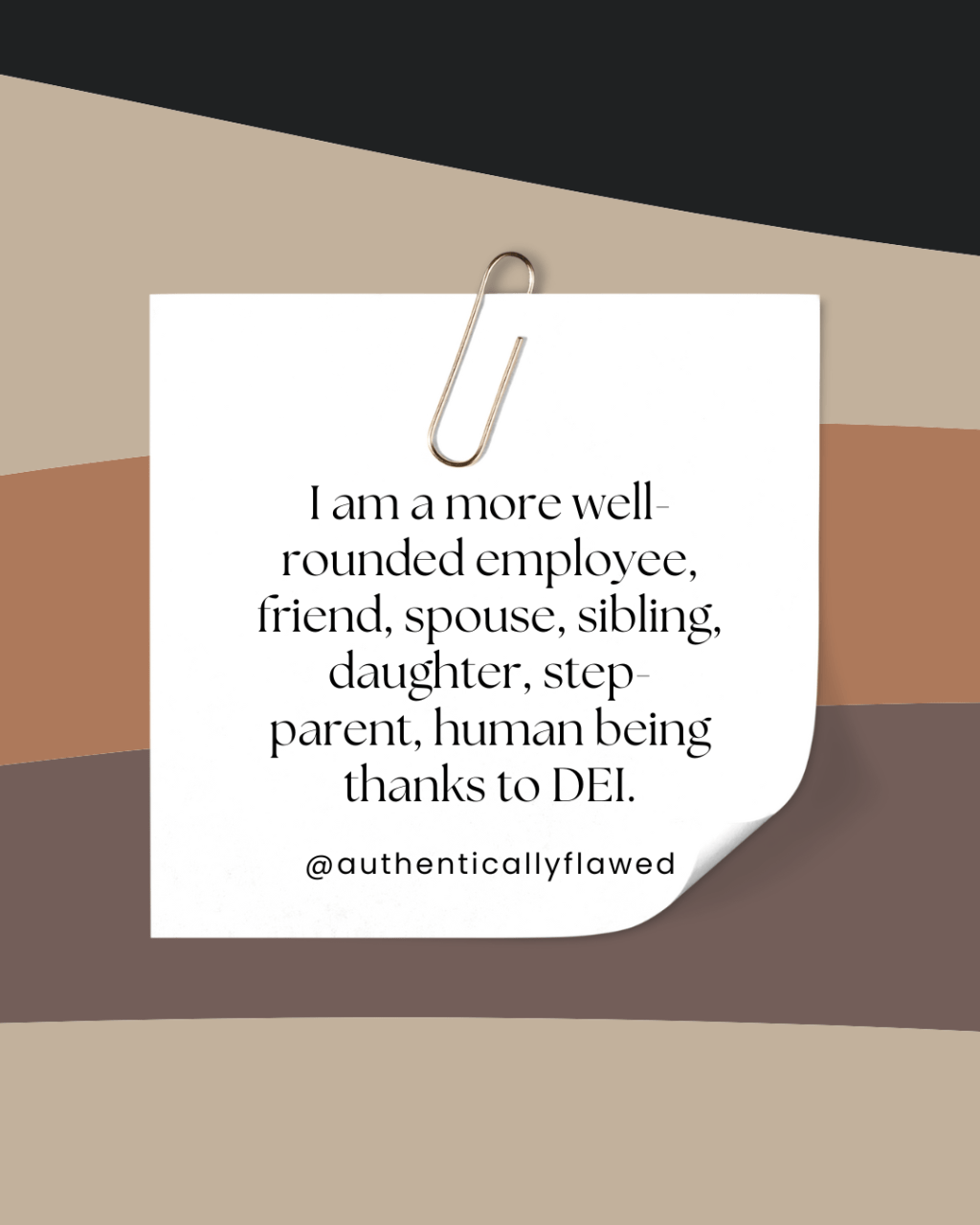
– In addition to programs in support of racial equity and inclusion, DEI has supported programs for parents and caregivers in the form of enhanced paid leave for mothers and wait for it…fathers. It is responsible for fertility and family planning benefits packages, accessibility standards for persons with disabilities (and the inclusive language that prevents us from calling them handicapped), programs to ensure that when our veterans return from fighting for our freedoms, they can rejoin civilian life and have opportunities to thrive. New mothers can pump in privacy and peace thanks to DEI. Employees like me can learn about other cultures and nuanced experiences thanks to DEI. I am a more well-rounded employee, friend, spouse, sibling, daughter, step-parent, human being thanks to DEI.
We have a long road ahead, fam. Before you buy in to the narrative that DEI is harmful, I hope you’ll read and internalize this account, and do your own research on these programs. It’s not just about Black and brown people, and we can’t and we won’t back down. For those who support DEI, I stand with you and exhausted as I am, I’m prepared for this fight.

 Authentically Flawed
Leave a comment